 LevelZMOD
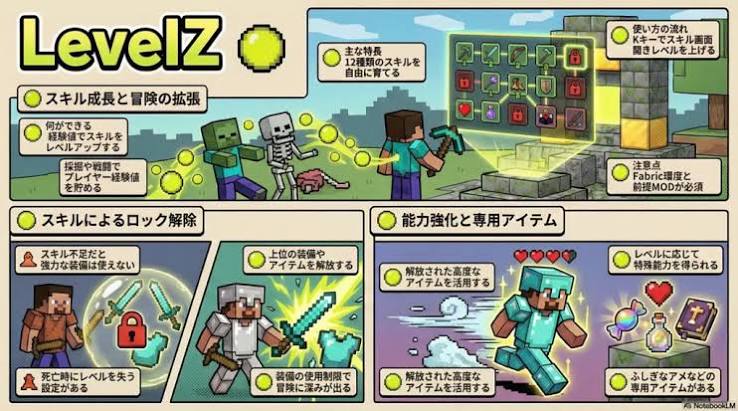
A good LevelZ build begins with a useful activity and the equipment needed to perform it. It does not begin with a universal instruction to maximise one skill, because different packs can change available skills and restrictions.
Use this skills guide to choose a short progression route, check it against the current interface and avoid spending points toward an ability that your installed mods do not provide.
Read the active skill descriptions
Open the skill interface and examine the descriptions supplied by your release or pack. Write down the available points and the values relevant to the equipment you want.
The official LevelZ overview explains that skills and restrictions can be added or changed. Therefore, an illustrated chart should not be treated as a guaranteed list of active bonuses.
Choose a goal before an allocation
A goal can be using a better tool, preparing a combat loadout, or accessing a frequently needed interaction. Make it concrete enough to test.
For example, wanting to gather a particular resource is clearer than wanting a strong character. Inspect the tool and block requirements associated with that resource, then identify what currently prevents the activity.
Compare build priorities
| Desired activity | What to inspect | What not to assume |
|---|---|---|
| Resource gathering | Tool use, target block and processing access | A faster-looking tool bypasses all restrictions |
| Close-range combat | Usable weapon, protection and recovery | A named role automatically grants class abilities |
| Ranged play | Weapon requirements, ammunition and repair access | Every ranged item uses identical rules |
| Group support | Actual support items and their integration | A healing ability exists without a supporting mod |
The table is a planning aid. It does not assert fixed LevelZ values or a mandatory class system.
Spend points toward the limiting requirement
Complete a useful step
If one investment completes a requirement for a frequently used item, compare it with spreading the same points across several distant goals. An accessible improvement often has an immediate practical benefit.
Check every requirement on the intended item. Meeting one value does not mean that another listed condition disappears.
Test what changed
After spending points, perform the intended action in a safe place. A change in the interface is evidence of the allocation, while a successful interaction confirms the practical result.
If the action still fails, record the message and compare the requirements again. Do not spend additional points merely because a video recommends a higher overall level.
Keep long-term plans flexible
You can plan several later upgrades without committing every point immediately. Revise the plan when you discover a new resource route, a changed rule or an item with an unexpected dependency.
Do not assume that points can be reset freely. A pack may provide a particular recovery mechanism, but that needs to be verified in its actual documentation and setup.
Evaluate a shared-server build
A group can coordinate equipment and activities, but each player's requirements still matter. Confirm who can use the item being shared before relying on it during an encounter.
If the server expects specialised roles, clarify whether essential activities remain accessible to a new player alone. A build plan should not depend on an unavailable teammate without an alternative route.
Skill-planning questions
What is the best skill to level first?
The one that removes your most important current obstacle under the active rules. There is no verified universal allocation for every pack.
Are all pictured bonuses guaranteed?
No. The supplied infographic is illustrative, and installed descriptions are the relevant reference.
Why did copying a build not unlock my item?
The release, addon or restriction may differ. Inspect your own tooltip and exact item variant.
What should I read next?
Use the resource route guide for gathering goals or the combat preparation guide for a complete fighting loadout.